In 1943 Lockheed was one of the largest machines on earth for making airplanes. It had grown from fewer than 2,000 people in 1937 to more than 90,000, it lived on government contracts, and by the end of the war it would push 23 airplanes a day out of its doors.1 That June the US Army came to it with an urgent request for something new, and all that size turned out to be in the way. The plant had no room for the job. So the new airplane was designed under a rented circus tent, by 22 engineers Kelly Johnson had picked by hand.2
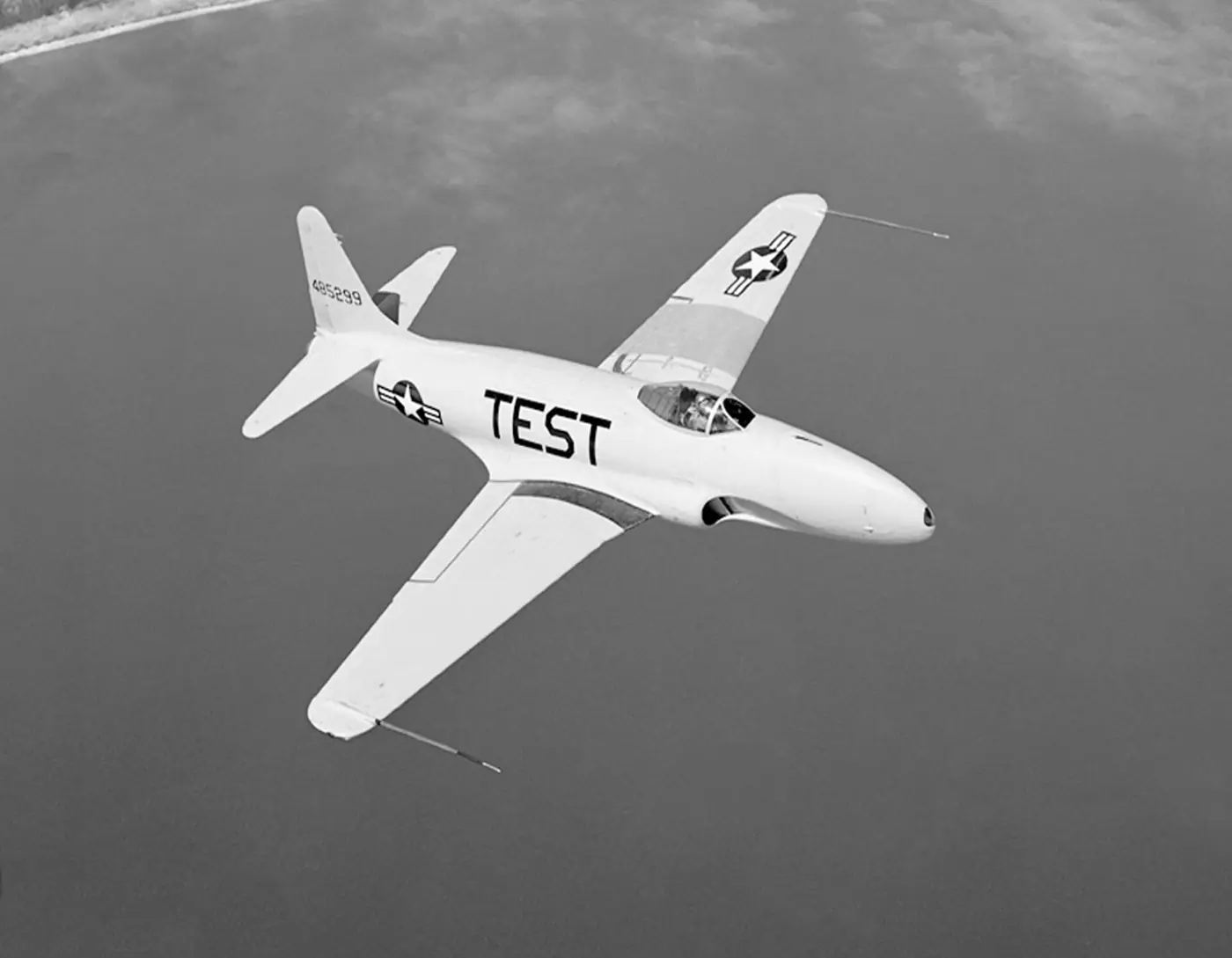
The job was a jet fighter. Germany already had one, the Me 262, about 90 miles an hour faster than anything the Allies flew.3 The Army had a British jet engine and no American airplane to put it in. Johnson's team delivered the XP-80 in 143 days, a week early.4 It came too late to fight in that war. It was the first of a run.
Five firsts
The tent became the Skunk Works, named after a reeking still in the comic strip Li'l Abner. A shop that good could afford a joke for a name; the more competent you are, the less serious you need to be. Over the next four decades it built five airplanes that each did something no airplane had done, and Ben Rich, who ran it after Johnson, lists them himself:5
- P-80 Shooting Star, 1944. The first jet fighter the US Army Air Forces put into service, and the first of its jets past 500 miles an hour.4
- F-104 Starfighter, 1954. The first production airplane to fly at twice the speed of sound, on wings so thin at the front edge, 0.4 millimetres, that ground crews fitted guards over them so nobody got cut.6
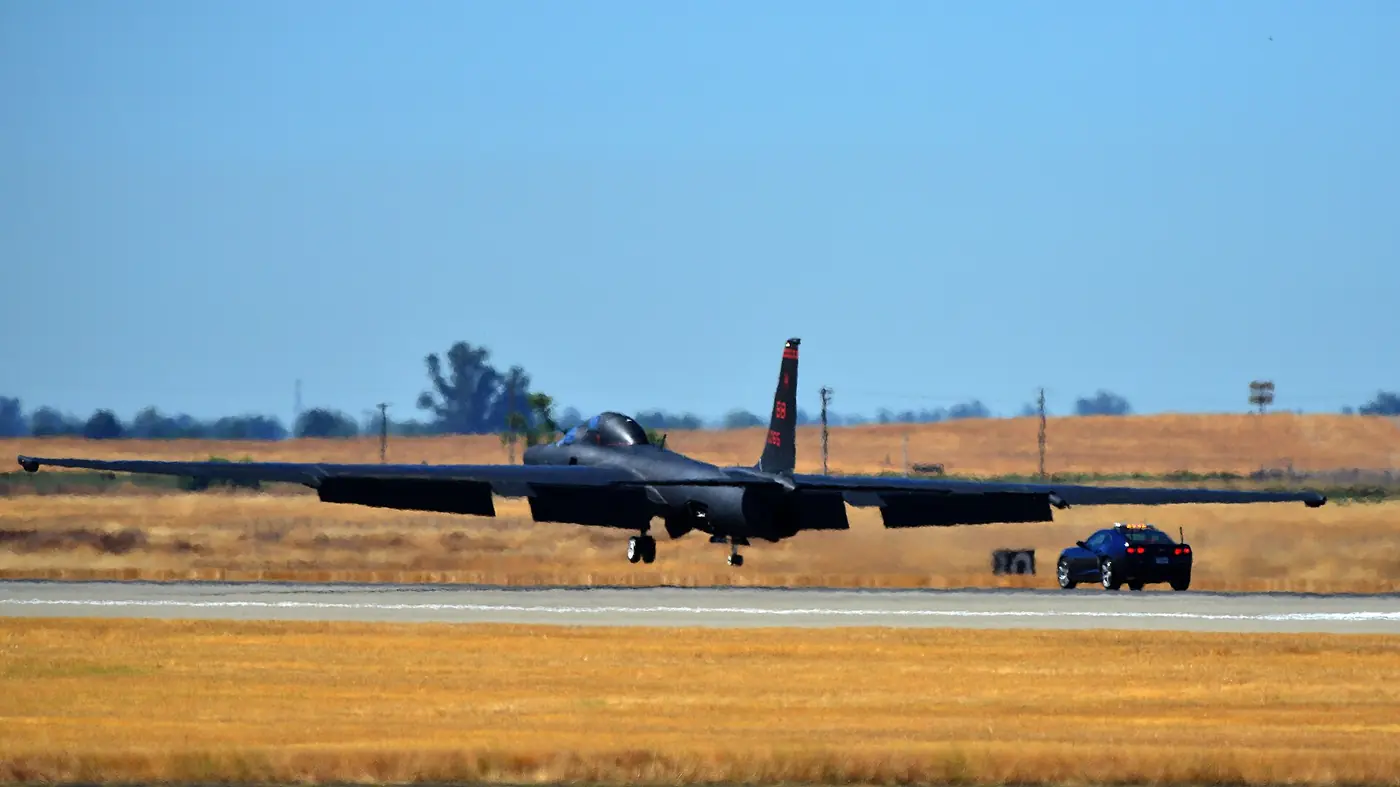
- U-2, 1955. A jet-powered glider that flew over the Soviet Union from above 70,000 feet, so high its pilot wore a pressure suit. It still lands with a second pilot racing behind it down the runway in a car, calling out the height.7
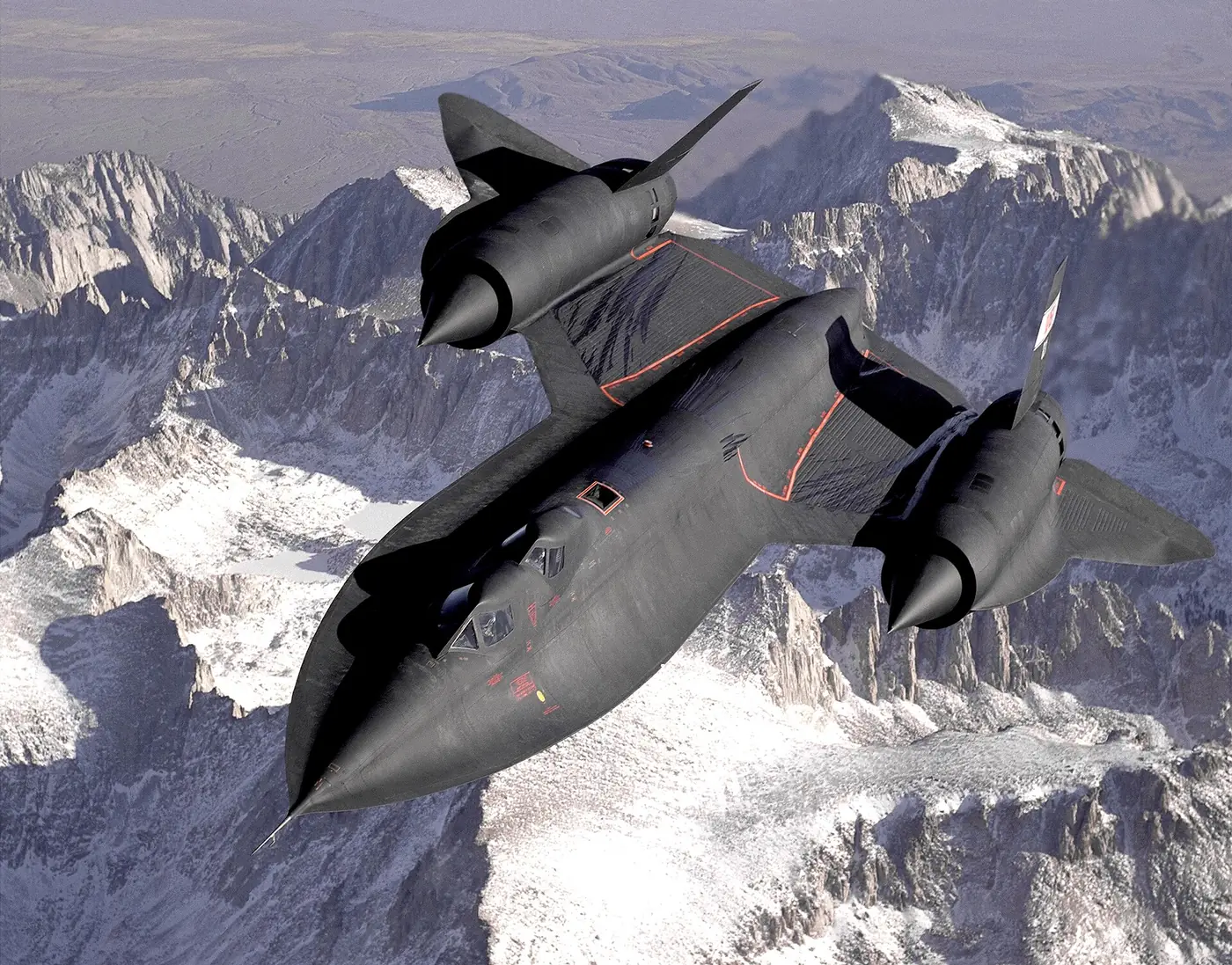
- SR-71 Blackbird, 1964. Built mostly of titanium, because at three times the speed of sound its skin heated past 260 degrees Celsius. It was made to fit when hot: on the ground its fuel tanks leaked onto the runway, and sealed only once the skin warmed in flight. Since 1976 nothing with a pilot and a jet engine has flown faster.8
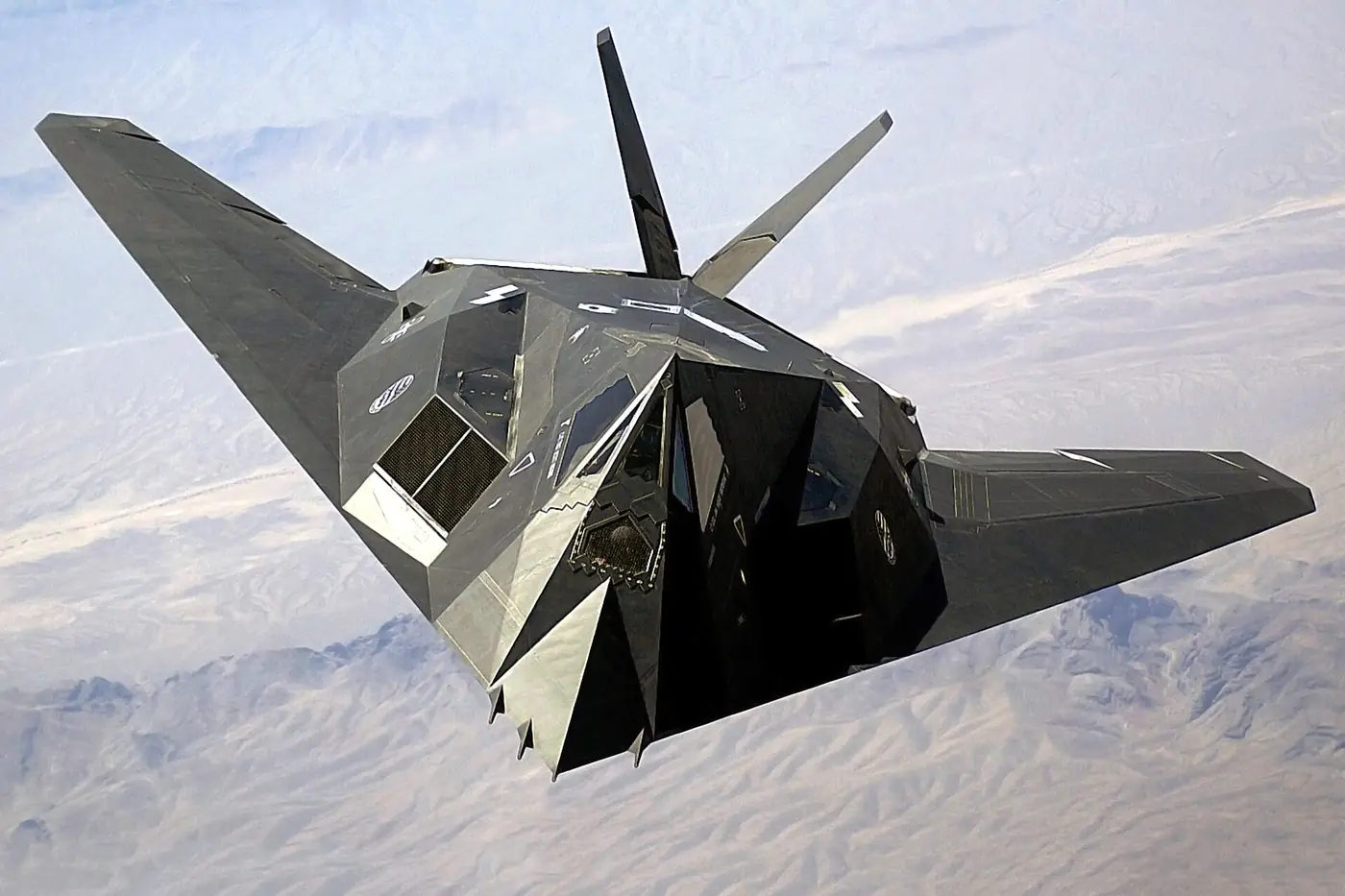
- F-117 Nighthawk, 1981. The first stealth aircraft in service, shaped like a cut gem because the 1970s software that predicted its radar echo could only handle flat surfaces. The equations behind it came from a Soviet physicist, and the Air Force denied it existed for seven years.9
"Best" would be too generous for all of them. West Germany lost 292 of its 916 Starfighters and 116 pilots, and Germans called it the widowmaker.6 "First" holds every time.
The rest of Lockheed had the same name on the door and the same government paying the bills. In 1971 it was the largest defence contractor in the United States, and it needed a $250 million federal loan guarantee to survive an airliner.10 So money does not explain the difference.
Why giants stop inventing
A big company is a machine for repeating what worked. Ninety thousand people building P-38s need procedures, and good ones: they are why 23 airplanes came out every day. A procedure is a decision somebody made once so that nobody has to make it again, and a new airplane is made almost entirely of decisions nobody has made before. The machine that makes the known thing cheap makes the unknown thing slow and expensive, with exactly the same parts. And an untried idea has to compete for money with work that is already earning; Clayton Christensen called this the innovator's dilemma, and noticed that the firms it beats are usually the well-run ones.11
Every part is reasonable, which is why nobody removes it. When Johnson was sent to rescue the Agena rocket stage, he found 1,206 people in quality control and a reliability of 13.6 percent.12 Each inspector had been hired to stop a real failure. Together they were enough people, he wrote, to design and build the thing.
Then there is the arithmetic. Every pair of people on a project is a conversation that might need to happen: five people make ten pairs, fifty make 1,225.13 Anyone who has tried to choose a restaurant for twelve knows the rest. Most of those pairs never talk, but the more people there are, the more desks a decision has to visit, and every one of them can say no.
And there is pay. In most companies the manager of forty earns more than the manager of four. Reward a manager for building a bigger department and a bigger department is a reasonable thing to build. Johnson told Rich the main plant gave raises "on the basis of the more people being supervised; I give raises to the guy who supervises least", and he put it in his fourteenth rule.1214
How the skunk did it
Johnson's answer was a small room inside the giant, paid for by the giant, with the giant's habits kept outside. His third rule says the people connected with a project "must be restricted in an almost vicious manner".14 The U-2 never had more than 81 people on it, and they handed back $2 million of a $22 million budget.12 Designers sat "two feet apart" from the people who built and tested what they drew, so a drawing that could not be built got argued over before lunch.12 One person decided, and someone above him took the pressure. Rich told his engineers: "I'll take the crap from the big wheels, but if you screw up I want to hear it first."5
Even the great exception worked this way. Bell Labs had about 5,700 people in 1950, paid for by the AT&T telephone monopoly, and the transistor, which the modern world more or less runs on, came out of one small mixed group of physicists, chemists and metallurgists inside it in 1947.15
The giant's reflexes are strong, and copies usually lose to them. The Army's Cheyenne helicopter tried Johnson's method and within six months had a purchasing department larger than his whole engineering department.12 When investors made Olivetti sell its electronics division to General Electric in 1964, five engineers kept the desk computer they were building by renaming it a "calculating machine", which was not in the deal. The Programma 101 sold about 44,000 units, and NASA bought some for Apollo.16
What a beaver has
Castor, which is also Latin for beaver, is two people making open-source software and these essays. Johnson's arithmetic is very kind to two: one pair, one conversation. Ours never really stops, because we live together, so most ideas reach the other person while they are still half a thought. Nobody above us has to approve anything. A decision takes as long as it takes us to agree.
We also have what Johnson never had: agents. They add hands without adding people who need persuading, and the cost moves to context. People pick context up fast, in a corridor, and there is a limit to how much they hold; agents pick up nothing by being in the room, but they can work from far more than a person can hold, as long as someone wrote it down. So most of our work has become scoping: saying what we want precisely enough to hand it over, with just enough structure that nobody has to guess, and a check at the end. The risk is the one Johnson fought, in a new costume. Generate work faster than we can judge it and we will have our own sprawling department, conveniently stored on a computer. If it starts to happen, we make the jobs smaller before we add more agents.
The rule we most want to keep is the one about pay, because growth breaks it first: the day there is money to hire, the easiest way to look successful is to have more people. Nobody is offering us that money yet, so we wrote down what we reward while it costs nothing, in The myth of values as a competitive advantage, and why we commit slowly in Startup decelerator.
Every giant was once a few people who could decide before lunch. The skunk needed a tent to hide from its own company. We would like to grow without ever needing one.
Notes
1 U.S. Centennial of Flight Commission, "Lockheed in Mid-Century": fewer than 2,000 employees at the end of 1937, more than 90,000 by 1943; by 1945, 23 planes a day and $2 billion in war contracts. https://centennialofflight.net/essay/Aerospace/Lockheed_in_Mid-Century/Aero15.htm. In the war Lockheed and Vega built 19,278 aircraft, six percent of US production: "Lockheed Corporation", Wikipedia. https://en.wikipedia.org/wiki/Lockheed_Corporation ↩︎
2 Lockheed Martin, "Skunk Works origin story": the June 1943 meeting about the "rapidly growing German jet threat", the rented circus tent because no space was available at the plant, Irv Culver and Li'l Abner, and the XP-80 "in only 143 days, seven less than was required". https://www.lockheedmartin.com/en-us/who-we-are/business-areas/aeronautics/skunkworks/skunk-works-origin-story.html. The 22 engineers are from Johnson's memoir More Than My Share of It All (1985), quoted in Gilliam (below). ↩︎
3 "Messerschmitt Me 262", Wikipedia: the first operational jet fighter, over 530 mph, about 93 mph faster than any Allied fighter operational in Europe. https://en.wikipedia.org/wiki/Messerschmitt_Me_262 ↩︎
4 "Lockheed P-80 Shooting Star", Wikipedia: "the first jet aircraft to be used operationally by the United States Army Air Forces" (the Bell P-59 flew first but never went into service as a fighter); built around the British Halford H-1 "Goblin" engine; first flight 8 January 1944; the first turbojet USAAF aircraft to exceed 500 mph in level flight; two pre-production aircraft reached Italy and never engaged in combat. https://en.wikipedia.org/wiki/Lockheed_P-80_Shooting_Star ↩︎ ↩︎
5 Ben R. Rich and Leo Janos, Skunk Works: A Personal Memoir of My Years at Lockheed (1994), chapter 1: "some of our inventions", the P-80, F-104, U-2, SR-71 and F-117A; and "I'll take the crap from the big wheels". ↩︎ ↩︎
6 "Lockheed F-104 Starfighter", Wikipedia: first flight 4 March 1954 (XF-104); the first production aircraft to reach Mach 2; leading edges "so thin (.016 in; 0.41 mm) that they were a hazard to ground crews", so guards were fitted during maintenance; West Germany lost 292 of 916 aircraft and 116 pilots between 1961 and 1989, and the German public called it Witwenmacher, widowmaker. https://en.wikipedia.org/wiki/Lockheed_F-104_Starfighter ↩︎ ↩︎
7 "Lockheed U-2", Wikipedia: first flight 1 August 1955; "essentially a jet-powered glider"; above 70,000 feet; first Soviet overflight 4 July 1956; the S1034 pressure suit; the chase car "driven by a second U-2 pilot who assists the landing U-2 by reporting the aircraft's altitude"; still operated by the USAF and NASA. https://en.wikipedia.org/wiki/Lockheed_U-2 ↩︎
8 "Lockheed SR-71 Blackbird", Wikipedia: first flight 22 December 1964; titanium for 85 percent of the structure; external surface "well beyond 500 °F (260 °C)" at Mach 3.2; panels that fitted loosely on the ground and tanks that "only sealed when the skin warmed", so it "leaked JP-7 fuel on the ground before takeoff"; the fastest air-breathing manned aircraft since 1976, a record it still holds. https://en.wikipedia.org/wiki/Lockheed_SR-71_Blackbird ↩︎
9 "Lockheed F-117 Nighthawk", Wikipedia: "the first operational aircraft to be designed with stealth technology"; first flight 18 June 1981; its faceted shape "resulted from the limitations of the 1970s-era computer technology used to calculate its RCS"; existence denied until 10 November 1988. "Pyotr Ufimtsev", Wikipedia: Lockheed's Denys Overholser built on Ufimtsev's 1962 book on the physical theory of diffraction. Rich's Skunk Works tells the story at length. The F-22, whose prototype came from the same shop, would make the five six ("Skunk Works", Wikipedia). ↩︎
10 "Lockheed Corporation", Wikipedia: on 13 May 1971 the Nixon administration asked Congress for a $250 million loan guarantee for Lockheed, "then the largest US defense contractor", and its L-1011 TriStar programme. Rich (chapter 1) describes Lockheed as "nearly bankrupt" from the TriStar. ↩︎
11 Clayton M. Christensen, The Innovator's Dilemma (1997), whose argument is that well-managed firms miss new technologies by doing what good management asks: serving their best customers and investing where margins are highest. ↩︎
12 Eric Gilliam, "Managing Lockheed's Skunk Works", The Good Science Project, which quotes Johnson's memoir and Rich's Skunk Works at length: the Agena's 1,206 inspectors and 13.6 percent reliability; Johnson's raise line to Rich; the U-2 project never passing 81 people and the $2 million returned; staff "two feet apart"; the Cheyenne copy's purchasing department. https://goodscienceproject.org/articles/managing-lockheeds-skunk-works/ ↩︎ ↩︎ ↩︎ ↩︎ ↩︎
13 A team of n people has n(n-1)/2 pairs who may need to talk. Frederick P. Brooks Jr. made the point about software projects in The Mythical Man-Month (1975). ↩︎
14 Kelly Johnson's 14 rules of management, rules 3 and 14. https://www.lockheedmartin.com/content/dam/lockheed-martin/aero/photo/skunkworks/kellys-14-rules.pdf ↩︎ ↩︎
15 Mervin Kelly, "The Bell Telephone Laboratories: an example of an institute of creative technology", Proceedings of the Royal Society A (1950), quoted in FreakTakes, for the 5,700 people https://www.freaktakes.com/p/bonus-more-details-on-how-bell-labs; "Mervin Kelly", Wikipedia, for the interdisciplinary solid-state group https://en.wikipedia.org/wiki/Mervin_Kelly; Jon Gertner, The Idea Factory (2012), for AT&T's funding and the transistor of December 1947. ↩︎
16 Inexhibit, "Olivetti Programma 101: la storia ed il design del primo personal computer", for the sale to General Electric, the team of five (Pier Giorgio Perotto, Giovanni De Sandre, Giuliano Gaiti, Gastone Garziera, Giancarlo Toppi) and the change from "computer" to "calculating machine" https://www.inexhibit.com/it/case-studies/olivetti-programma-101-la-storia-ed-il-design-primo-personal-computer/; "Programma 101", Wikipedia, for about 44,000 sold and about ten bought by NASA for the Apollo programme https://en.wikipedia.org/wiki/Programma_101. ↩︎